- Welcome my DevOps blog./
- 🔰Posts/
- 🗂️My Trainings/
- AWS Trainings and Certifications/
- 🏅AWS Certified Solutions Architect - Associate/
- Solutions Architect: Databases in AWS/
Solutions Architect: Databases in AWS
Table of Contents
🔥 Associate‑level extension of the Databases section from the AWS Cloud Practitioner series.
| AWS Certifications Series » | |
|---|---|
| AWS Cloud Practitioner | AWS Solution Architect |
Choosing the right Database #
- AWS offers many managed databases, so the choice depends on your workload and architecture
- Key questions to guide selection:
- Is the workload read‑heavy, write‑heavy, or mixed? Does throughput need to scale or vary during the day
- How much data will you store, how fast will it grow, and how will it be accessed
- What level of durability and “source of truth” guarantees do you need
- Required latency and expected concurrency
- What data model fits: structured, semi‑structured, joins, query patterns
- Do you need a strict schema or flexibility? Reporting? Search? RDBMS vs NoSQL
- Any licensing costs to consider, or opportunities to move to cloud‑native engines like Aurora
Database Types #
- RDBMS / OLTP (SQL): RDS, Aurora - best when you need joins
A join is an operation in SQL that lets you combine data from multiple tables based on a related value they share. Joins allow complex queries across multiple datasets, They enforce relationships between entities (users → orders, products → categories, etc.), they’re essential for OLTP / RDBMS workloads where data is normalised.
RDS and Aurora are relational databases - they’re designed for this kind of multi‑table querying.
NoSQL systems like DynamoDB don’t support joins, which is why data modelling is very different there.
Example join query:
SELECT users.name, orders.amount
FROM users
JOIN orders ON users.user_id = orders.user_id;
Result:
| name | amount |
|---|---|
| Bob | 50 |
- NoSQL: DynamoDB (JSON‑style), ElastiCache (key/value), Neptune (graph), DocumentDB (MongoDB‑compatible), Keyspaces (Cassandra)
- Object Storage: S3 for large objects, Glacier for archival
- Data Warehousing / Analytics: Redshift (OLAP), Athena, EMR
- Search: OpenSearch for free‑text and unstructured queries
- Graph: Neptune for relationship‑focused data
- Ledger: QLDB for immutable, cryptographically verifiable records
- Time Series: Timestream for time‑stamped data
Amazon RDS - Summary #
🏅 Cloud Practitioner-level: Amazon RDS
🏅 Solutions Architect Associate level extension: Amazon RDS
- Fully managed relational databases: PostgreSQL, MySQL, MariaDB, Oracle, SQL Server, DB2, plus RDS Custom for deeper OS/instance access
- You choose instance size and EBS volume type/size, with storage auto‑scaling
- Supports Read Replicas and Multi‑AZ for availability and read scaling
- Security via IAM, Security Groups, KMS encryption, and SSL
- Automated backups with PITR (up to 35 days), plus manual snapshots for long‑term retention
- Includes managed maintenance (with downtime)
- Supports IAM authentication and integrates with Secrets Manager
- Ideal for relational/OLTP workloads needing SQL queries and transactions
Amazon Aurora - Summary #
🏅 Cloud Practitioner-level: Amazon Aurora
🏅 Solutions Architect Associate level extension: Amazon Aurora
- MySQL/PostgreSQL‑compatible engine with separate compute and distributed storage
- Storage keeps 6 copies across 3 AZs, auto‑scales, self‑heals; compute scales via multi‑AZ clusters and read replicas
- Cluster endpoints for writer and readers
- Shares RDS features for security, monitoring, and maintenance
- Supports PITR, snapshots, fast database cloning, and S3 import/export
- Aurora Serverless handles spiky or unpredictable workloads with no capacity planning
- Aurora Global offers low‑latency global reads with sub‑second replication
- Aurora ML integrates with SageMaker and Comprehend for in‑database ML inference
- Best for RDS‑style workloads needing higher performance, more automation, and richer features
Amazon ElastiCache - Summary #
🏅 Solutions Architect Associate level extension: Elasticache
- Fully managed Redis/Memcached service (similar to RDS but for caching)
- In‑memory store with sub‑millisecond latency
- Choose from cache‑optimised instance types
- Supports Redis clustering, Multi‑AZ, and read replicas (sharding)
- Security via IAM, Security Groups, KMS, and Redis Auth
- Offers backups, snapshots, and PITR
- Includes managed maintenance
- Requires app‑level changes to use effectively
- Ideal for key/value workloads, heavy‑read patterns, DB query caching, and session storage (no SQL)
ℹ️ Note: Using ElastiCache involves heavy application code changes.
DynamoDB - Summary #
🏅 Solutions Architect Associate level extension: DynamoDB
- Fully managed, serverless NoSQL database with consistent millisecond latency
- Supports provisioned (with auto‑scaling) and on‑demand capacity modes
- Can act as a key/value store (e.g., session data) with TTL
- Highly available, Multi‑AZ by default; supports transactions and decoupled read/write paths
- DAX adds microsecond‑latency read caching
- Security, auth, and access control handled entirely through IAM
- DynamoDB Streams enable event‑driven processing via Lambda or Kinesis
- Global Tables provide active‑active multi‑region replication
- Backups: PITR (35 days) and on‑demand snapshots; restores create a new table
- Export to S3 (no RCUs) and import from S3 (no WCUs)
- Flexible schema evolution
- Ideal for serverless apps, small JSON‑like documents, and distributed low‑latency caching
Amazon S3 - Summary #
- S3 is a key/value object store, ideal for large objects (less efficient for many tiny files)
- Fully serverless, infinitely scalable, supports versioning; max object size 50 TB
- Storage tiers: Standard, Infrequent Access, Intelligent‑Tiering, Glacier (with lifecycle policies)
- Core features: versioning, encryption, replication, MFA‑Delete, access logs
- Security via IAM, bucket policies, ACLs, Access Points, Object Lambda, CORS, Object/Vault Lock
- Encryption options: SSE‑S3, SSE‑KMS, SSE‑C, client‑side, TLS, default encryption
- Bulk operations with S3 Batch, inventory reports for listing
- Performance tools: multipart upload, Transfer Acceleration, S3 Select
- Event automation via SNS, SQS, Lambda, EventBridge
- Use cases: static hosting, large object storage, scalable key/value storage
DocumentDB #
- AWS’s managed, MongoDB‑compatible NoSQL database for storing and querying JSON
- Similar deployment model to Aurora, but for MongoDB workloads
- Fully managed, highly available with replication across 3 AZs
- Storage auto‑expands in 10 GB increments
- Designed to scale to millions of requests per second
Amazon Neptune #
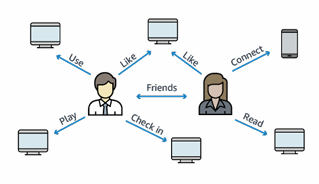
- Fully managed graph database for highly connected datasets
- Ideal for social‑network‑style relationships (users, posts, comments, likes, shares)
- Replicated across 3 AZs with up to 15 read replicas
- Handles billions of relationships with millisecond‑level query latency
- Optimised for complex graph queries that are hard for relational/NoSQL systems
- Great for knowledge graphs, fraud detection, recommendation engines, and social networks
Amazon Neptune - Streams #
- Provides a real‑time, strictly ordered feed of all graph data changes
- Updates appear immediately with no duplicates
- Stream data is accessible via an HTTP REST API
- Use cases:
- Trigger notifications on specific graph changes
- Keep another data store (S3, OpenSearch, ElastiCache, etc.) in sync
- Support cross‑region Neptune replication
Amazon Keyspaces (for Apache Cassandra) #
- Fully managed, serverless, Cassandra‑compatible NoSQL database
- Automatically scales up/down with traffic; highly available with 3× replication across AZs
- Uses CQL and delivers single‑digit millisecond latency at massive scale
- Supports on‑demand or provisioned capacity (with auto‑scaling)
- Provides encryption, backups, and PITR (Point-In-Time Recovery) up to 35 days
- Great for IoT data, time‑series workloads, and large‑scale distributed apps
Amazon Timestream #
- Fully managed, serverless time‑series database that auto‑scales with demand
- Handles trillions of events per day, delivering far lower cost and much faster performance than relational DBs
- Supports scheduled queries, multi‑measure records, and SQL‑compatible querying
- Tiered storage: recent data in memory, historical data in cost‑optimised storage
- Built‑in time‑series analytics for near real‑time pattern detection
- Encrypted in transit and at rest
- Ideal for IoT, operational monitoring, and real‑time analytics
Data & Analytics #
Amazon Athena #
- Serverless SQL query engine for data stored in S3 (built on Presto)
- Supports formats like CSV, JSON, ORC, Avro, Parquet
- Pricing: $5 per TB scanned
- Often paired with QuickSight for dashboards and reporting
- Great for analytics on logs such as VPC Flow Logs, ELB logs, CloudTrail
- Exam tip: use Athena to run serverless SQL queries directly on S3
Redshift #
- Analytics‑focused OLAP data warehouse (PostgreSQL‑based but not for OLTP)
- Delivers 10× faster performance than traditional warehouses and scales to petabytes
- Uses columnar storage and a massively parallel query engine
- Available as provisioned or serverless
- Queried using standard SQL; integrates with BI tools like QuickSight and Tableau
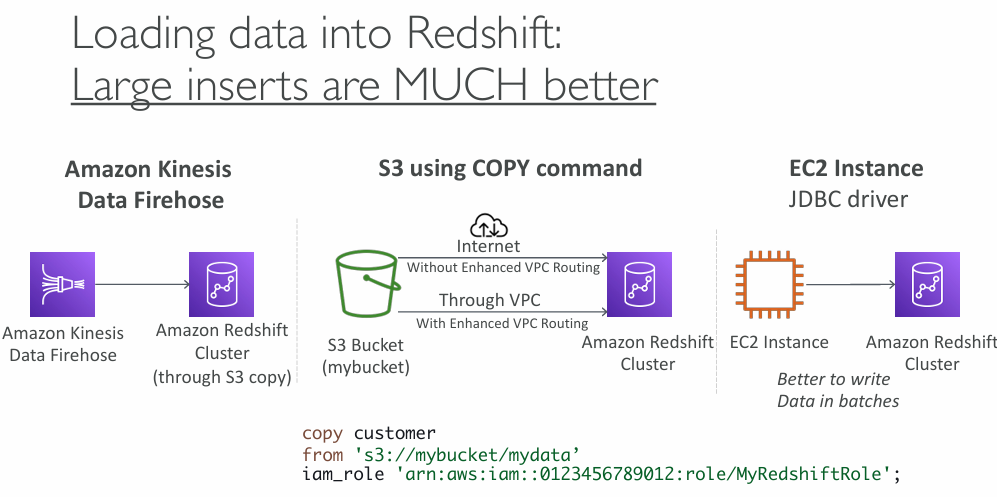
- Compared to Athena: faster for complex joins and aggregations due to indexing
Redshift Spectrum #
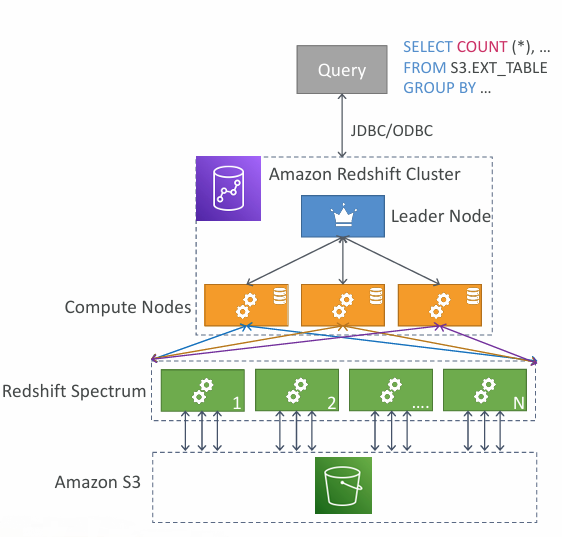
- Lets you query data directly in S3 without loading it into Redshift
- Requires an active Redshift cluster to run the query
- Queries are executed by thousands of Spectrum nodes for large‑scale parallel processing
Amazon OpenSearch Service #
- Successor to Amazon Elasticsearch, offering full‑text and partial‑match search across any field
- Complements other databases (e.g., DynamoDB) by enabling rich search beyond key/index lookups
- Available as managed or serverless clusters
- SQL support is optional via a plugin
- Ingests data from Kinesis Firehose, AWS IoT, and CloudWatch Logs
- Security via Cognito, IAM, KMS encryption, and TLS
- Includes OpenSearch Dashboards for visualisation
Amazon EMR #
- Managed Hadoop/Spark platform for large‑scale data processing
- Spins up clusters of hundreds of EC2 instances for big data workloads
- Bundles tools like Spark, HBase, Presto, Flink
- Handles provisioning, configuration, and auto‑scaling; supports Spot Instances
- Ideal for ETL, machine learning, log processing, web indexing, and other big‑data pipelines
Amazon QuickSight #
- Serverless, ML‑powered Business Intelligence service for building interactive dashboards
- Fast, auto‑scaling, embeddable, with per‑session pricing
- Use cases: business analytics, visualisations, ad‑hoc analysis, data insights
- Integrates with RDS, Aurora, Athena, Redshift, S3, and more
- Can use the in‑memory SPICE engine for high‑speed querying
- Enterprise edition adds Column‑Level Security (CLS)
AWS Glue #
- Fully managed, serverless ETL service for preparing and transforming data
- Automates data discovery, cleaning, and schema handling for analytics
- Ideal for building scalable, code‑optional ETL pipelines
- Glue Job Bookmarks: prevent re-processing old data
- Glue DataBrew: clean and normalize data using pre-built transformation
- Glue Studio: new GUI to create, run and monitor ETL jobs in Glue
- Glue Streaming ETL (built on Apache Spark Structured Streaming): compatible with Kinesis Data Streaming, Kafka, MSK (managed Kafka)
AWS Lake Formation #
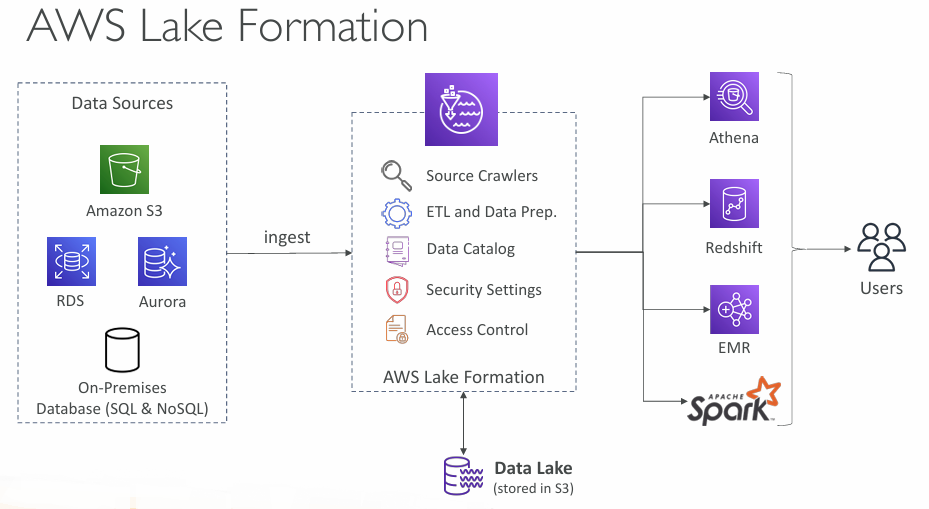
- Fully managed service for quickly building a centralised data lake
- Automates data discovery, cleansing, transformation, ingestion, and cataloging (with ML‑based de‑duplication)
- Supports combining structured and unstructured data
- Provides fine‑grained row/column‑level access control
- Includes blueprints for common sources (S3, RDS, relational/NoSQL DBs)
- Built on top of AWS Glue
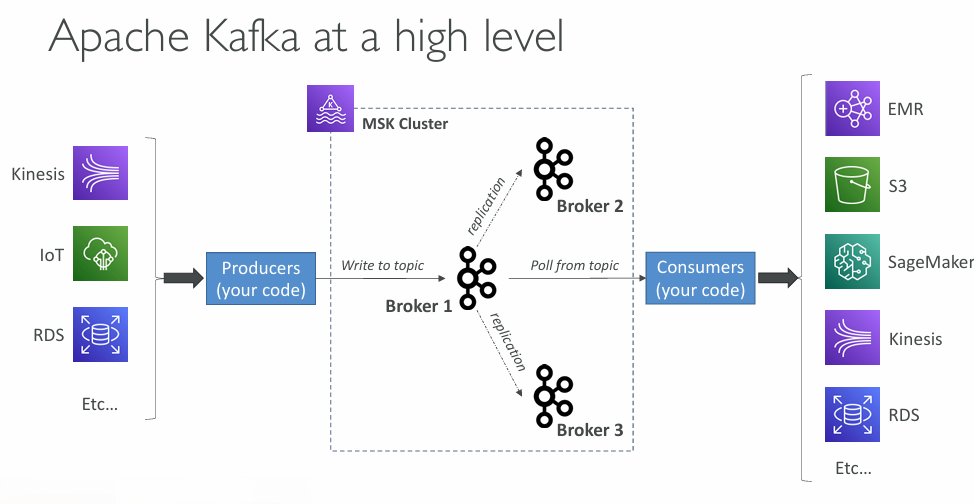
Amazon Managed Streaming for Apache Kafka (Amazon MSK) #
- Fully managed Apache Kafka service on AWS; alternative to Kinesis
- AWS handles broker and ZooKeeper provisioning, updates, and recovery
- Deploys in your VPC, supports multi‑AZ (up to 3) for high availability
- Data stored durably on EBS for as long as needed
- MSK Serverless: Kafka without capacity management—compute and storage scale automatically
» Sources « #
» References « #
Cloud Practitioner:
Solutions Architect:
» Disclaimer « #
This series draws heavily from Stephane Maarek’s Ultimate AWS Certified Solutions Architect Associate 2026 course on Udemy.
His content was instrumental in helping me pass the certification.
| About the instructor | |
|---|---|
| 🌐 Website | 📺 YouTube |
| 𝕏 x.com |